Nationwide
Northern Lights
A solar storm made visible, best seen away from the lights
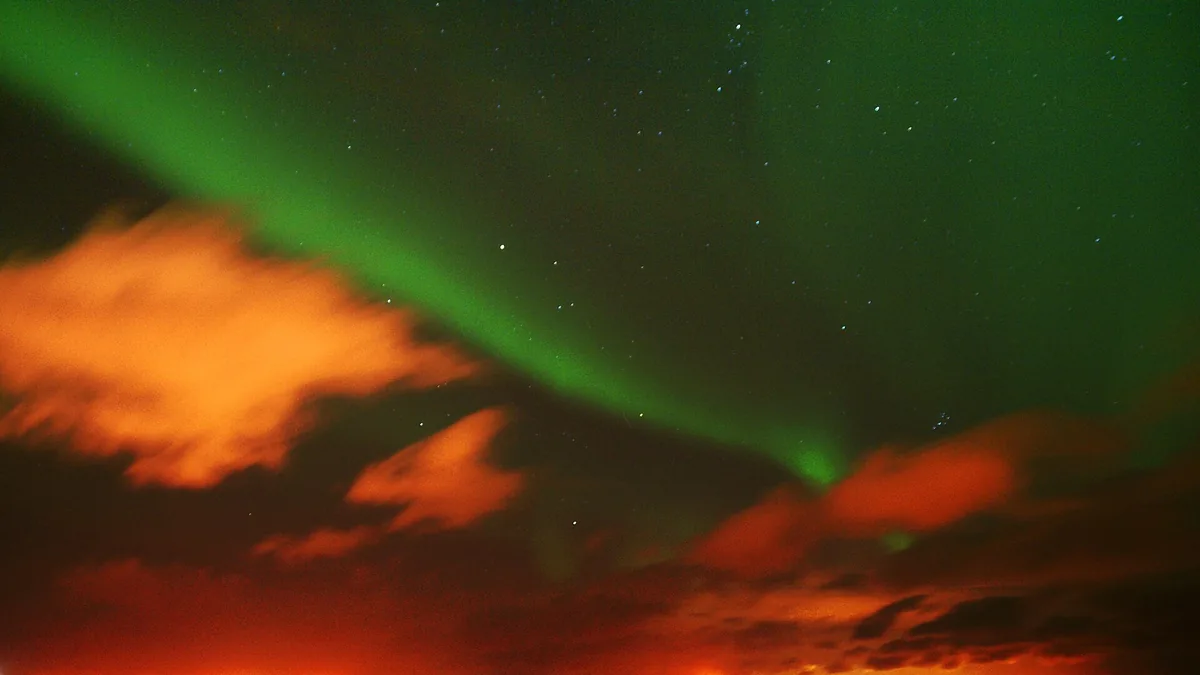
Photo: Milan Nykodym from Kutna Hora, Czech Republic · CC BY-SA 2.0
Iceland sits under the auroral oval, and between September and March the aurora borealis is visible on clear nights across most of the country.
What you are actually seeing
The aurora is caused by charged particles from the sun, carried by the solar wind, colliding with oxygen and nitrogen in the upper atmosphere. The colours depend on which gas is excited and at what altitude: green from oxygen at around 100 to 300 kilometres, red from oxygen higher up, and blue-purple from nitrogen. The activity follows an 11-year solar cycle, and the current cycle, cycle 25, is near its maximum in 2025-2026.
Where and how to look
You need clear sky, darkness and patience. The forecast sites (vedur.is and the NOAA space weather centre) give a Kp index and cloud cover; a Kp of 3 or above, with clear skies, is usually enough at Iceland's latitude. The best places are away from Reykjavik's light dome: Thingvellir, the Snaefellsnes coast, the south coast around Vik, and the east fjords. Guided tours exist but a car and a dark car park work just as well.
Photographing it
A modern phone on a night mode can capture the green colour that the eye sometimes reads as grey. For a camera, use a wide lens, a tripod, an aperture of f/2.8 or wider, ISO 1600-3200 and a 5-15 second exposure. Keep your eyes adapted: no white torches, no phone screens. And be careful on the roads at night in winter, which are icy and unlit.
Three things not to miss
- Aurora over the church at Thingvellir
- The lights reflected in a still lake on the south coast
- A green corona directly overhead during a strong solar storm
In pictures
Every photo in this guide is freely licensed, credited, and available at full resolution from Wikimedia Commons.
Nearby in the atlas